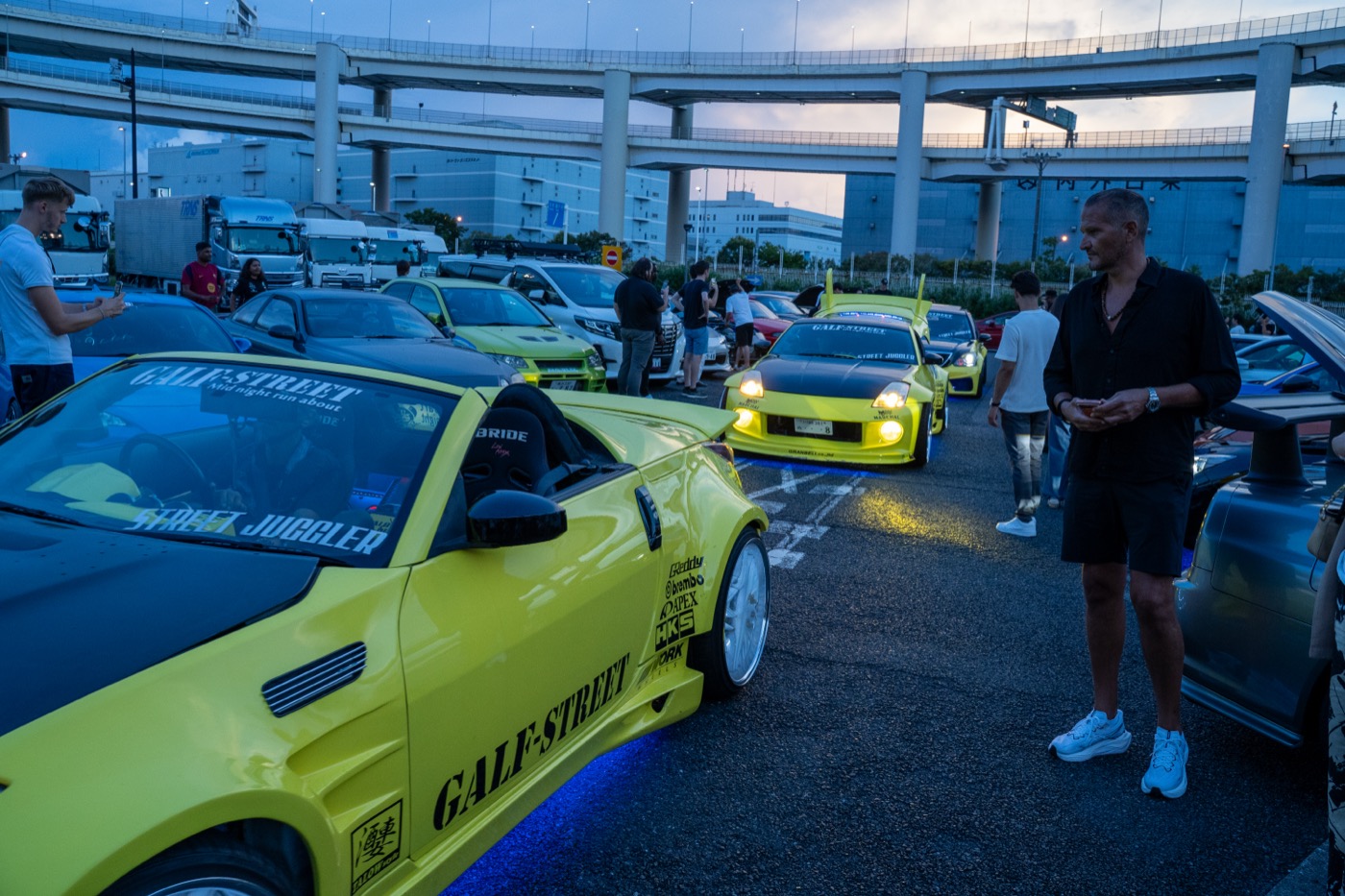
Daikoku PA Field Notes:
50 Nights, GPS-Logged
Between 30 April 2023 and 15 August 2026 I photographed Daikoku PA on 50 separate nights. Every one of those visits left a timestamp and a GPS coordinate embedded in a file. This page is what those 97 records show — and, just as importantly, what they don't.
The Honest Version First
Most pages about Daikoku PA tell you it's busiest on a Saturday and leave it there. I could have written that too, and my own data would have appeared to back up something quite different. Instead, let me be precise about what I actually measured.
I did not count cars. I have no turnstile, no camera on a pole, no headcount. What I have is a record of every time I was standing in that parking area with a phone in my hand, accurate to the minute and to a few metres.
That makes this a good dataset for one question and a bad dataset for another.
It answers well: what time of night the lot is worth being at. I don't photograph an empty parking area, so a timestamp is indirect evidence that something was happening.
It answers badly: which weekday is busiest. My weekday distribution measures when I was free, not when cars showed up. In 2024 I went mostly on Tuesdays; in 2026 mostly at weekends. Daikoku didn't change — my schedule did.
I'd rather say that plainly than publish a chart that looks authoritative and quietly misleads you.
When the Lot Is Actually Active
This is the finding I stand behind. Of 97 records taken on site, 86 — that's 89% — fall between 17:00 and 23:59. The single most common hour is 21:00.
Two things stand out. There's an early cluster around 17:00–18:00, which is the golden-hour window when the light is still worth shooting and the first cars are arriving. Then activity dips slightly around 19:00 before the real peak at 20:00–23:00.
That 19:00 dip is consistent with something I'd tell you anyway: people eat. The lot thins out for an hour and then fills again.
What this means for a visit
If you have one night and want the highest chance of seeing something, arrive around 20:30 and stay until at least 23:00. If you also want photographs with any ambient light in the sky, come at 17:30 as well — but understand that the cars worth seeing usually turn up later.
How Long People Stay
On the 27 nights where I have more than one timestamp, the median gap between my first and last record is 34 minutes.
That number surprised people when I mentioned it. It shouldn't. Daikoku is a parking area on an expressway loop, not a venue. Cars arrive, park, people talk, and then a group leaves together for a drive. The population turns over continuously. A car you see at 21:00 may well be gone by 21:40, replaced by three others.
This is the single most useful thing to understand about Daikoku: it is a flow, not a crowd. Turning up for twenty minutes and concluding "it was dead" is a common mistake. Stay ninety minutes and you'll see three different sets of cars.
Seasons
My records cluster in summer — 21 nights across June, July and August, against 12 across December, January and February. October is my thinnest month with a single night in three years.
I want to be careful here, because the same bias applies: I'm more inclined to stand outside in July than in January, so some of that gap is me. But not all of it. Cold, wet nights genuinely suppress turnout, and for a straightforward reason — a lot of these cars are cherished, and their owners won't take them out in bad weather.
| Season | Nights recorded |
|---|---|
| Summer (Jun–Aug) | 21 |
| Spring (Mar–May) | 12 |
| Winter (Dec–Feb) | 12 |
| Autumn (Sep–Nov) | 5 |
What I Know That the Data Doesn't Show
Three years of turning up teaches you things a timestamp can't capture. These are observations, not measurements, and I'm labelling them as such.
Weekends draw the biggest turnout
Friday and Saturday nights are, without question, the busiest. My own visit log doesn't demonstrate this — as I said, it reflects my diary — but it is what I've seen consistently since 2023. If your trip allows only one night and you want volume, make it a Friday or Saturday.
But weekdays are rarely empty
A quiet Tuesday still puts cars in that lot. Fewer of them, and often a different crowd — more regulars, fewer spectators. Some people prefer it. You can actually talk to owners on a Tuesday in a way that's harder when the place is packed.
Weather beats the calendar
If I had to pick one variable to predict a good night, it would be the forecast, not the day of the week. A clear Wednesday will beat a rainy Saturday almost every time. Check the Yokohama forecast before you commit to a date, and if it's wet, consider moving your plan.
Nothing is guaranteed, by anyone
Daikoku has no organiser. There's no schedule to consult and nobody to ask. Anyone promising you a specific car or a specific number of cars is guessing. What you can do is stack the odds — right hours, right weather, enough time on site.
Method
For anyone who wants to judge the data rather than take my word for it.
Each record is a photo or video I took, from which I read the embedded capture metadata: EXIF DateTimeOriginal and GPS tags for stills, QuickTime creationdate and ISO6709 location for video. Timestamps are Japan Standard Time. Files without usable timestamps were discarded rather than estimated.
A record counts as "at Daikoku" only if its GPS coordinates fall within 2km of 35.4616°N, 139.6803°E. Two files that fell outside that radius were excluded, as were seven with no location data at all. Multiple records on the same night collapse into one "night", with the boundary drawn at 06:00 so that a session running past midnight stays attached to the evening it began.
Devices: an iPhone 13 for 73 of the records and an iPhone 17 Pro for 24, reflecting a handset change partway through the period.
↓ Download the raw data (CSV, 97 records) — timestamps and approximate coordinates for every record used on this page, so you can rerun the numbers yourself.
No figure on this page was estimated, rounded up, or reconstructed from memory. Where I've relied on recollection rather than data — the weekend and weather observations above — I've said so explicitly.
Questions
89% of my 97 on-site records fall between 17:00 and 23:59, and 21:00 is the most common single hour. Activity continues past midnight but falls away sharply after 01:00.
Median recorded time on site is 34 minutes. Cars cycle through rather than settling in, so the lineup changes substantially over an evening.
My data can't tell you — it reflects my availability, not the car count. From three years of observation, Friday and Saturday draw the largest turnout, though weekdays are rarely empty.
In my experience, yes. A dry weekday often beats a wet weekend, because owners won't bring valued cars out in the rain.
No. There's no organiser, no timetable and no guest list. Turnout ranges from a handful of cars to several hundred with no announcement either way.
From the embedded capture metadata of every photo and video I took on site — timestamp and GPS. Only files within 2km of Daikoku PA were counted. Nothing was estimated.
Daikoku PA Tour (¥15,000/pp) · What is Daikoku PA? · How to Get There · Opening Hours · Police & Closures · Daikoku vs Tatsumi · Is It Worth It? · Best Time to Visit
Or skip the guesswork
I go anyway. If you'd rather not work out the timing, the entrance and the etiquette on your own, come along — 3 hours, Shibuya pickup at 20:00, from ¥15,000.
Check availability →Read Next
→ The Best Time to Visit Daikoku PA
→ Is Daikoku PA Open? The closure rules